Sued over an old credit card in Oklahoma? The company has to prove 4 things. Here is how to make it.
Just got served, and thinking oh sh*t, I'm being sued? This booklet walks you through what to do, and what not to do:
- Your first course of action
- How to verify everything they claim
- Your rights, before you ever walk into court
- How to fight back, and win
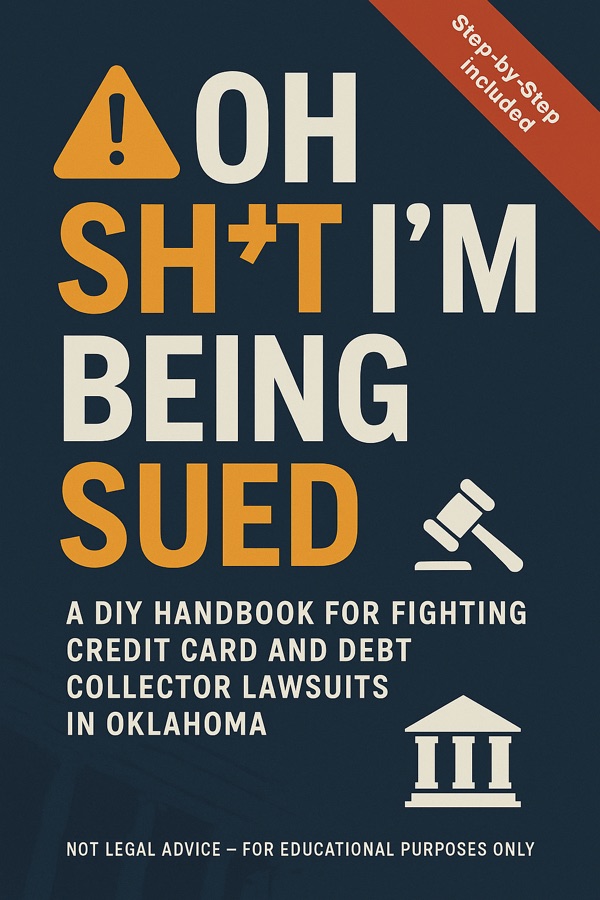
Oh Sh*t, I'm Being Sued. What to do next. Brought to you by Fight Back Strong.
Educational information, not legal advice. We are not attorneys and we do not represent you.
Sued by LVNV Funding, Midland Credit Management, Portfolio Recovery Associates, Cavalry, Jefferson Capital, or the bank itself? Read this.
Hey, it's L.C.
The papers are on your kitchen table. You have read the first page three times and it still does not make sense. Your stomach is in a knot, and you keep asking yourself the same questions.
Can they take my paycheck? My car? My house? Do I need a lawyer I cannot afford? What happens if I just do nothing?
First, breathe. You are not going to jail. This is a civil case about money.
And you are not the only one. Hundreds of thousands of these get filed every year, mostly against ordinary people who hit a bad stretch. Life gets messy. None of it makes you a bad person. It just makes you human.
Here is who is suing you, and what they are counting on
The company on your papers is very often not your bank. It is a company that bought your old account in a stack of thousands. When the Federal Trade Commission studied these companies, it found they paid an average of 4 cents on the dollar. A $3,000 balance can cost them about $120.
Then they file lawsuits by the stack, and their whole business runs on one thing:
You doing nothing.
Because when nobody answers and nobody shows up, the court enters judgment by default. The company never has to prove a single thing. Not that it owns your account. Not that the balance is right. Nothing.
And that is how most of these end. The Pew Charitable Trusts found that in the courts it studied, more than 70% of debt lawsuits ended in a default judgment.
What a judgment really costs: a real Oklahoma case
This one is straight from the court file. Real case. We left the name off.
A debt buyer sued over an old credit card for $4,377.77. The whole petition was one paragraph: the account was assigned to them, and the defendant "owes Plaintiff $4,377.77." No contract. No statements.
Nobody filed an answer. About nine months later the judge signed a default judgment:
- $4,377.77, the debt
- $299.14, court costs and the process server
- $437.77, "a reasonable attorney's fee," exactly 10% of the debt
- plus interest, every year, until it is paid
$5,114.68 on day one.
Then the garnishments started. Six filings in two years: three against bank and credit union accounts, three against paychecks. Five came back empty: not employed there, account closed, no account. A garnishment only works if they find your paycheck or your money.
But the judgment did not go away. Every filing added court costs. By 2023 the company swore under oath the balance was $5,894.85.
That is $1,517 more than the debt, 35% more, and not one dollar had been paid.
This year, the company filed to renew the judgment for five more years. It is still out there.
And it does not stop. In Oklahoma a judgment only dies if five years go by with nothing filed. Every garnishment and every renewal restarts that five year clock. As long as they keep filing, it keeps going.
That is what staying home costs.
What it could cost you
Here is what the same math looks like on your paycheck, using that case's 10% attorney fee and court costs, plus Oklahoma's 2026 judgment interest rate of 8.75%.
First, the rule: Oklahoma protects 75% of your pay after taxes. The other 25% can be garnished, every payday, through a garnishment that runs 180 days. Then they can file the next one, and it starts the day the last one ends. Each new filing adds more fees.
| You were sued for | Your take home pay | They can take | It takes about | Total taken from your pay |
|---|---|---|---|---|
| $4,000 | $800 a week | $200 a week, about $867 a month | 6 months | $4,979 |
| $8,000 | $800 a week | $200 a week | 11 and a half months | $9,842 |
| $4,000 | $400 a week | $100 a week, about $433 a month | 12 and a half months | $5,342 |
| $8,000 | $400 a week | $100 a week | 24 and a half months | $10,515 |
Month by month, sued for $8,000, bringing home $800 a week:
| Month | Taken from your pay so far | Still owed |
|---|---|---|
| 1 | $800 | $8,533 |
| 3 | $2,600 | $6,851 |
| 6 | $5,200 | $4,376 |
| 9 | $7,800 | $2,023 |
| 11 and a half | $9,842 | paid off |
Look at month one. After $800 comes out of your check, you owe more than you were sued for, because the costs, the attorney fee and the interest got there first.
These are examples, not a prediction for your case. Your numbers depend on your judgment, your pay and what the court allows. Educational information, not legal advice.
Every one of those judgments starts with one missed date.
Numbers on a page are one thing. Not long ago I talked with a mother of three. The judgment had been taking money out of every paycheck since February. She was behind on the house and scared she would lose it. She did not know where to go, could not afford a lawyer, and had no idea what came next. I have seen this cost a family their home.
Here is what they do not want you to know
They usually bought a spreadsheet, not your file.
The same Federal Trade Commission study found that for most of the portfolios they bought, the buyers did not receive any documents at the time of purchase. No signed agreement. No statements. A line of data with your name on it.
Now watch what happens when you show up. Here is what I have seen, over and over in 25 years.
The company's lawyer stood up with one piece of paper, and the judge would not accept it. The judge gave them 30 days to come back with real proof. Most of the time, they never came back. They dropped the case, because they knew they did not have the proof.
The people I walked through this who showed up and made the company prove its case did not walk out with a judgment against them. And it is not just my people. Texas publishes its court numbers statewide, and in fiscal year 2025 about 4 in 10 debt cases there were dropped by the company or dismissed.
One trip to the courthouse could save you thousands of dollars, keep a judgment off your name, and stop a garnishment before it ever starts.
I cannot promise how your case turns out. Nobody honest can. But I can tell you this: a case decided on evidence is a very different thing from a case decided on silence.
Know your rights. Know the law. It is not complicated.
You do not need a law degree for this. You need to know what they have to prove, what the law already protects, and what to do next. You worked hard for your money. Make sure they follow the law. Get educated, protect yourself, and fight back strong.
Your biggest weapon is knowledge. This booklet comes from more than 25 years in the industry, working with people in debt and with the legal system through credit repair and debt collection. Everything that matters when the court papers are in your hand is in one booklet, set up step by step.
Oh Sh*t, I'm Being Sued: the Oklahoma Lawsuit Survival Booklet
It takes you from panic to a plan, in the order it happens:
- Educate. Learn what they actually have to prove, and what your state already gives you.
- Action. File the answer before your deadline, then make them prove it in writing.
- Results. A case decided on evidence instead of on silence.
Here is what changes for you
Tonight, instead of lying awake:
- Know in thirty seconds which kind of case you have. Oklahoma has two: small claims, where you get an Affidavit and an Order, and the regular civil docket, where you get a Petition and a Summons. They work completely differently, and mixing them up is how people miss the only deadline that matters.
- Know your exact deadline, counted the way the rules count it, written in big letters on your calendar.
This week, instead of guessing:
- Do the right things in the first 72 hours, in order, with a checklist.
- Steer clear of the eight mistakes that sink people, like the "let's work it out" phone call where anything you say gets written down, or the small payment that can restart the clock on an old debt.
In the courtroom, instead of freezing:
- Know the four things they have to prove: that you are the right person, that they own the account, that the amount is right, and that the claim is not too old. You do not have to prove you do not owe the money. You have to make them prove that you do.
- Say the right words, word for word, so your mind does not go blank when the judge looks at you.
- Use the Oklahoma rule most people never hear. A company that bought someone else's account is not allowed to use small claims court at all (12 O.S. 1751(B)). Most people sued there never find out. You will, and you will know how to raise it with the judge, politely and on the record.
- File your Answer without paying a lawyer to write it, part by part, if your case is on the regular civil docket.
When they offer a deal, instead of signing whatever they send:
- Settle on your terms, in writing, after you have responded, when the leverage is on your side. Never a payment you cannot make.
If they already got a judgment, instead of giving up:
- Protect your paycheck. Oklahoma protects seventy five percent of your wages, and if you support a family you can ask for a hardship hearing to protect more.
- Protect your benefits. Social Security, SSI and SSDI money cannot be garnished at all.
- Know your way back. What a judgment can reach, what it cannot, and the time limits to ask the court to reopen it.
And when you want a person, know exactly where to get free help in Oklahoma, starting with Legal Aid.
Look inside before you buy
Every section of the booklet:
- First, breathe. You are not going to jail.
- Figure out which kind of case you have
- The 72 hour checklist
- What the plaintiff has to prove, and what you get to ask
- What not to do
- Civil docket: what goes in an Answer
- Small claims: what to say in the room
- Settling, and when to talk
- If they already got a judgment
- After the case
- Where to get free help in Oklahoma
- Your case tracker
Ten pages. Plain English. Every statute in it was read from the official Oklahoma Statutes.
Everything you get today for $9.99
- The Oklahoma Lawsuit Survival Booklet, ten pages, on your phone tonight or printed and taken to the courthouse.
- The case tracker, as its own page, so you can print it twice: one to fill in, one clean spare. Every date, every filing, every offer in one place.
- The member area, with the booklet broken into 12 short lessons you can read one at a time when your head is spinning.
- 30 days of emails that walk you through the next steps as your case moves.
Put that next to what else is out there. One Texas firm that defends these cases publishes flat fees from $400 to $2,000, before hearings or trial. Other self help kits sell for $47 to $349.
This is $9.99. Less than your lunch.
Why so cheap?
Fair question. Here is the honest answer.
I want this in as many hands as possible, because the people who lose these cases mostly lose them for lack of information, not lack of rights. If $9.99 is what stands between somebody and knowing their deadline, I want them to have it.
Some people will want more help later, and there is more: the fill in forms with video walkthroughs, and a 30 minute review call where I go over your papers with you. I will tell you about those. But you do not need any of that to use this booklet. It stands on its own.
Your money back if it is not for you
Read it. If it does not help, email us within 7 days and you get every penny back. No hoops, no questions. Email [email protected] from the email you bought with. I am not going to hold your $9.99 hostage.
Do not put this off
Your deadline started the day you were served. On the regular civil docket you have twenty days to file a written Answer, unless the summons says thirty five. In small claims, your hearing date is on the order. Miss it and the company wins by default, without proving a thing.
You may not want to deal with this today. Nobody does. But the papers will still be on the table tomorrow, and the clock will still be running.
$9.99 now, or up to a quarter of every paycheck later. That is the real math.
How to get it
Click the button. Put in your name, email and phone, then your card. The booklet is on the very next page, and a copy goes to your email with your member area login.
One time charge. No subscription. Shows on your card statement as FIGHTBACKSTRONG.COM.
Questions
Is this legal advice? No. It is educational information so you understand the process, make better decisions, and ask a lawyer better questions if you talk to one.
Is it only for Oklahoma? Yes. Deadlines and court rules are different in every state.
How do I get it? Right after checkout, on the next page and by email. Your member area login comes in the same email.
My court date is close. Is it too late? No. Read Section 2 tonight, confirm your date with the court clerk tomorrow, and call Legal Aid Services of Oklahoma at 888-534-5243 if you need free help.
What if I really do owe the money? Owing money and a company proving its case in court are two different things. You do not have to prove you do not owe it. They have to prove that you do. And if you want to settle, Section 8 shows you how to do it in writing, after you have responded, when the leverage is on your side.
Can't I just call them and work out a payment plan? You can, but read Section 8 first. A phone agreement is not an agreement. Get the total, the dates, and a promise to dismiss the case in writing, and never agree to a payment you cannot make.
They already got a judgment. Is this still for me? Yes. Section 9 covers what a judgment can reach and what it cannot, how to protect your paycheck and bank account, and the time limits to ask the court to reopen it.
Do you file anything for me or go to court with me? No. We do not file anything, we do not represent you, and we do not appear in court. You read it, you fill it in, you file it, and you show up.
Do I need a lawyer? The booklet is built for people handling their own case. If you want a lawyer, Section 11 shows where to find free and paid help in Oklahoma, starting with Legal Aid.
Can I print it? Yes, as many times as you need.
Who wrote it? It is a compilation of 25 years of working with people who are in debt, and working in the legal system through credit repair and debt collection. Every statute in it was read from the official Oklahoma Statutes.
You can do this. You do not need to be a lawyer. You need to know what they have to prove, and you need to show up.
L.C.
Fight Back Strong
P.S. They paid about 4 cents on the dollar for your account, and they are counting on you to stay home. You do not have to prove you do not owe the money. They have to prove that you do. For $9.99 you will know exactly how to make them, and you can have it on your phone in the next five minutes.
Educational information, not legal advice. We are not attorneys and we do not represent you.
Need free legal help? Legal Aid Services of Oklahoma, 888-534-5243, for people who qualify.
Terms · Refund Policy · Privacy